

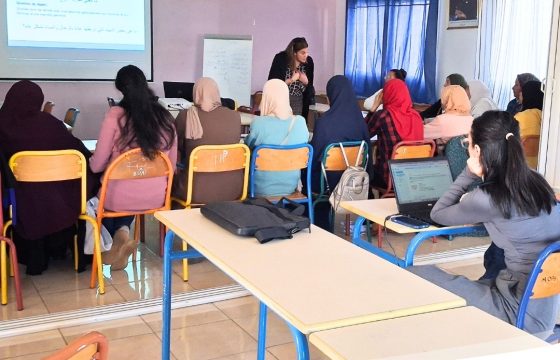

Article written by the Nabta Association with the support of Geres
Founded in 2015, Nabta Morocco is a local development association working in the areas of social and professional integration, education, and environmental protection. Its actions are particularly targeted at women and young people from precarious, rural, or peri-urban backgrounds. The association co-manages a multifunctional social center in El Menzeh (Skhirate-Témara Prefecture) with Entraide Nationale, which enables it to deliver state-recognized diploma courses in cooking, baking, IT, gardening, and sewing.
During its years of experience in the field of training, the association has observed the many difficulties faced by new graduates: low basic educational level, lack of self-confidence, gender and social status-related prejudices, fear of public speaking, difficulty in developing viable projects, lack of experience in financial management and marketing, etc.
This year, Nabta Maroc has therefore undertaken, through the Nabta Inserpro project—a 12-month project supported by Geres as part of the FAME project—to offer a support program to help trainees recognize, develop, and enhance their skills based on their career plans. This support program began with a core curriculum aimed at breaking down gender-based prejudices, improving self-esteem, and identifying professional and transferable skills. This article presents an exclusive look at the initial results.
Combating gender-based discrimination and overcoming prejudices to promote economic integration
Gender discrimination is the primary cause of women’s lack of economic integration worldwide. In order to combat these obstacles, the rights-based approach was first addressed, informing participants about the importance of the Universal Declaration of Human Rights: the right to life, freedom of thought, property, freedom of opinion and expression, etc. Despite its name, the Declaration of Human Rights applies equally to women, which is why the term “human rights” is now used to refer to these rights. On this basis, the issues of inequality and discrimination were addressed, fundamental human rights that are neglected on illegitimate grounds such as simply being a woman. The beneficiaries were encouraged to assert their rights and fight against these forms of injustice and violence in accordance with the Convention on the Elimination of All Forms of Discrimination against Women (CEDAW), ratified by Morocco in 1993.
A word from the trainer: “The participants were able to learn valuable lessons that will help them better understand the challenges of life and fight against various forms of discrimination they may face.”
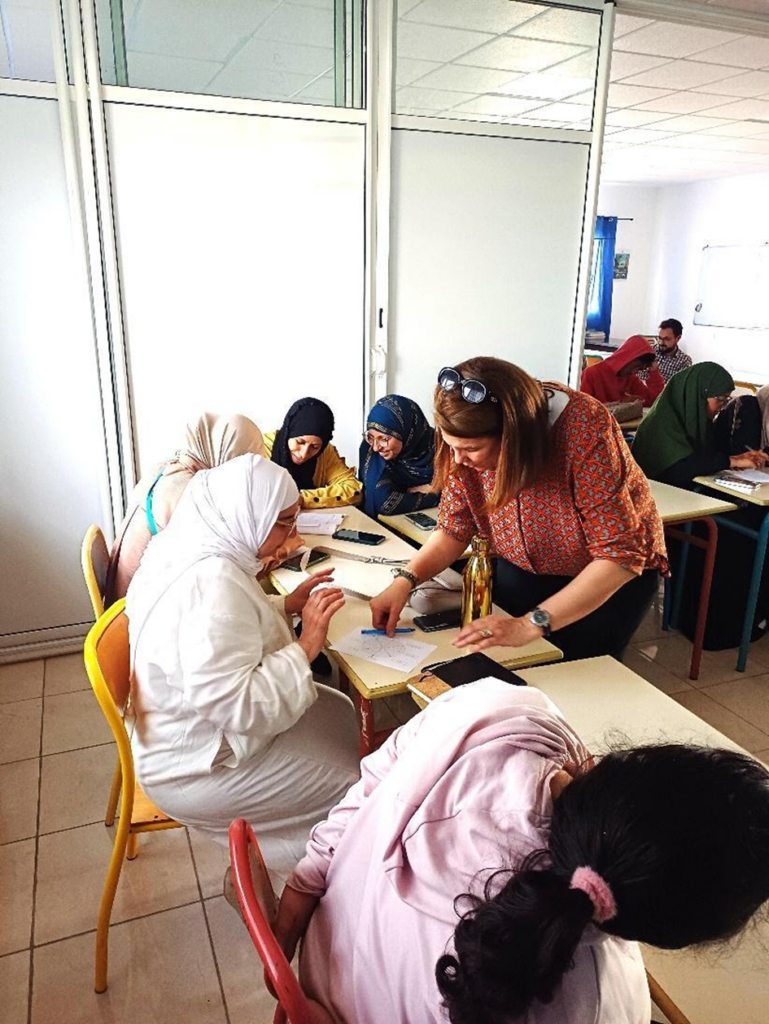
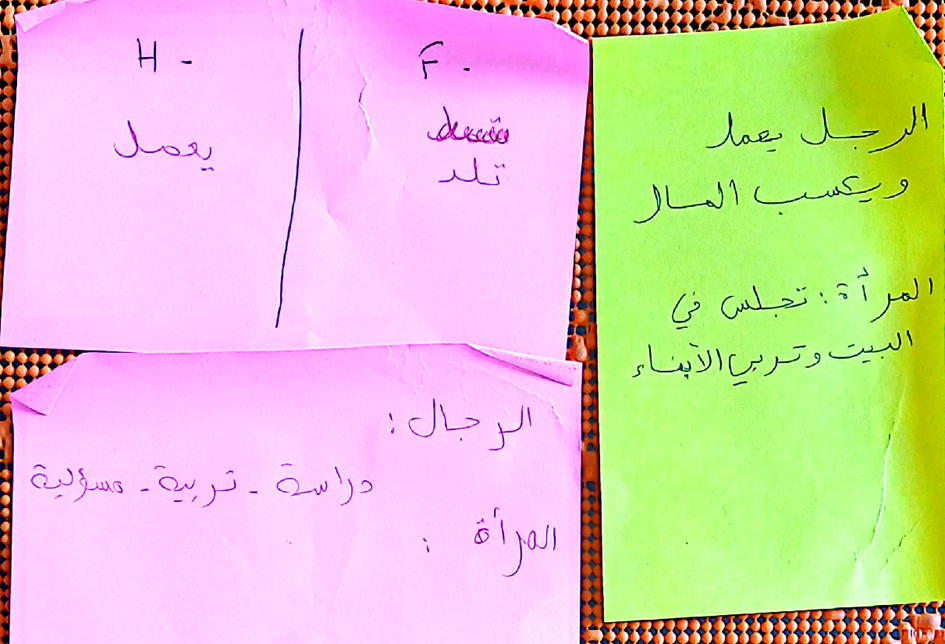
This session went far beyond the legislative framework of women’s rights. It also sought to reveal the prejudices that exist among the participants in the support program. To this end, the facilitator asked the participants to describe on Post-it notes their vision of the role of men and women in society. The opinions were unanimous: men study, work, and earn money; women take care of the home, children, and household chores. This very simple exercise stimulated numerous exchanges with the facilitator, who, , took it upon herself to dispel the social constructs identified through concrete examples taken from the real world, in which women are just as capable of performing tasks typically assigned to men, and vice versa. These remarks were very well received by the trainees, who gave very positive feedback on the discussions that took place during the training.
The discussions on gender stereotypes helped to establish an atmosphere of trust in which participants shared their personal experiences of social discrimination, a first step towards uniting in the fight against gender inequality.
SELF-ESTEEM AS A LEVER FOR SOCIAL AND PROFESSIONAL INTEGRATION
Before even developing a career plan, it is important to take the time to consider the available options and choose the one that best matches your values, desires, skills, and personality. This important step must be taken without restrictive thoughts such as “I’ll never be able to do it,” “What will my husband think?” or “What will people say?” This is the focus of the first part of the Nabta Inserpro project: participants free themselves from these unnecessary concerns so they can focus on their personal development by creating a personal and professional life plan.
Knowing oneself: a catalyst for changing mindsets
Three personal development sessions were organized to encourage trainees to reflect on themselves: what defines them, what they lack, what makes them feel good, and their aspirations. The facilitator’s goal was to define a starting point for each beneficiary, from which they could evolve toward their own personal goals.
During the first session, participants had the opportunity to use the “wheel of life,” a simple and intuitive tool designed to graphically assess their level of satisfaction in the different key areas of life (family, health, career, religion, etc.). This enabled them to identify imbalances and important aspects of their daily lives that they would like to improve. At the heart of this activity lies an essential concept: the “growth mindset,” according to which the “self” is never fixed, but constantly evolving, and our future is in our own hands. Negative thoughts such as “I’m useless” or “I’ve failed at life” are therefore no longer relevant. Each individual is capable of changing things to achieve their own balance in the wheel of life.
A word from the trainer: “This awareness will encourage them to adopt a new, more harmonious lifestyle in line with the values of tolerance and respect for others.”
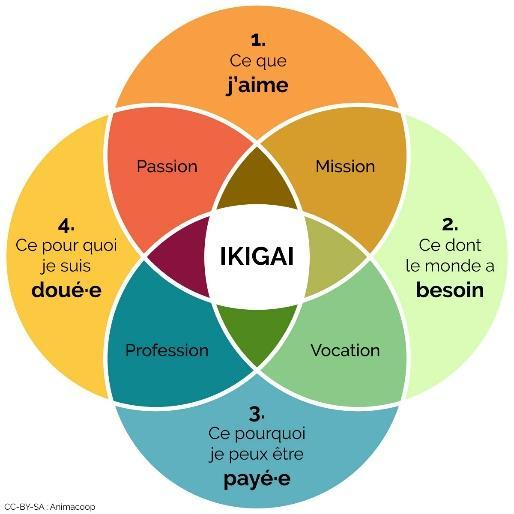
The trainees also learned how to use the IKIGAI tool, a practical method for building a career plan in line with their “self,” their skills, their life goals, and the needs of the world. This is an essential starting point for achieving lasting harmony between personal and professional life. This introduction to personal development sparked numerous discussions, exchanges of experiences and points of view, and profound reflections on the meaning of life. In the space of two and a half hours, the facilitator used these testimonials to cultivate a positive mindset among the participants, so that each obstacle they had experienced was no longer seen as a hindrance, but as an opportunity to learn and grow towards a personal and/or professional goal.
Nonviolent communication (NVC) and conflict management: the keys to better integration at work and in society
Regular, systematic verbal abuse aimed at hurting, humiliating, and threatening women is a form of gender-based violence, just like physical or sexual violence. No woman should have to endure this type of violence, whether at home or in public. If someone finds themselves in this type of situation, they can talk to a specialist organization.
Even in a healthy, violence-free relationship, communication can be complex and conflicts can arise. A better understanding of the “self” is essential for addressing the issue of relationships with others. The sessions on nonviolent communication (NVC) and conflict management were therefore based on personal development. During these two 2-hour sessions led by Ms. Latifa Benayad, participants learned to adopt a calm, respectful, and empathetic attitude when communicating.
This life lesson involves practicing impeccable communication, including thoughtful verbal, vocal, and body language. The facilitator also emphasized the need for considerable self-work in order to avoid taking criticism or disagreements personally, avoid unfounded judgments, and favor the clear and calm expression of feelings over uncontrolled verbal attacks. All these tips were put into practice in the form of role-playing games inspired by real-life situations: a neighbor who often comes to your house unannounced, a colleague’s phone ringing during class, someone taking your belongings without permission, etc.
A word from the trainer: “The participants understood that mastering NVC is an essential asset for better living and collaborating, whether in a professional or personal setting, by promoting harmonious and constructive relationships.”
By actively participating in the workshops, the trainees shared their own experiences of conflict, engaging in rich discussions with their colleagues and the facilitator. It emerged that certain forms of verbal abuse can be present within households, hence the importance of these sessions in better understanding others and responding diplomatically to confrontations. The aim was also to show participants that they could benefit from disagreements: if both parties engage in nonviolent communication, behind every disagreement lies an opportunity for learning, reflection, and constructive exchange that contributes to everyone’s personal development.
Conclusion
The Nabta Inserpro support program offers a choice of three paths following the core curriculum: salaried employment, self-employment, and cooperative creation. Introductory sessions on self-employment, cooperative creation, accounting, and cash flow have already taken place, giving participants an overview of the different paths before making their choice.
Each training path will be accompanied by individual support sessions managed by the National Agency for the Promotion of Employment and Skills (ANAPEC). A total of six months of personalized support is planned to enable each trainee to build their project step by step on a solid foundation. ANAPEC will also inform trainees of their rights as workers or job seekers and provide them with all the tools they need to access employment and navigate the job market with confidence and independence.

