

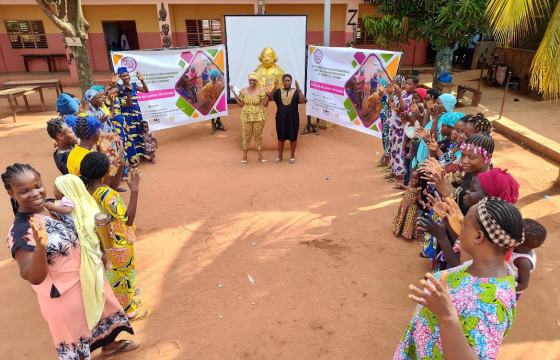

Article written by Geres and the Association of Deaf and Hard of Hearing Women of Ouémé (AFMSO).
Porto Novo – August 2025
“We live in a community where deaf women face triple discrimination: for being women, for being disabled, and for being uneducated.”
To put an end to these prejudices, in 2011 a group of deaf women decided to create an association in Porto Novo, the administrative capital of Benin, to defend their rights and help deaf women achieve financial independence: the Association of Deaf and Hard-of-Hearing Women of Ouémé (AFMSO). The association aims to promote sign language through the education and literacy of girls and women who are hard of hearing and/or deaf in sign language, to work for their social and educational integration, and to contribute to improving their living conditions.
“For us, the main achievement is having been able to create an association made up of women for deaf women in order to be able to defend our rights and make ourselves heard. Our awareness-raising activities have enabled several children to attend school and have enabled deaf women to learn about their rights and duties and to be able to claim them. Our literacy initiatives and training in income-generating activities have enabled some women to provide for their children. It is true that for the majority of deaf women, the situation remains complicated, but this is already an important step for us. We will not stop fighting as long as there is still work to be done.”
As part of the FAME (Feminism, Action, and Mobilization for an Inclusive Economy) project implemented in ten countries, including Benin, to strengthen the economic empowerment and agency of women and feminist CSOs, Geres has chosen to provide technical and financial support to this association for its project “Socio-economic Empowerment of Hearing-Impaired and Deaf Women in Ouémé” for a period of ten (10) months, from April 2025 to January 2026. The main objective is to enable deaf women to develop their leadership skills and achieve socio-economic autonomy.
During the first three months of the project’s implementation, AFMSO organized several capacity-building sessions for its members:
A first training session organized from May 5 to 8, 2025, in Porto-Novo at the Training Center for Sign Language, Interpreting, and Adapted Education (CFLSIPA) focused on sign language and enabled 35 hearing-impaired and deaf girls and women to improve their skills in order to open up better prospects for social and professional integration.
This training enabled them to explore the foundations and challenges of deaf culture, which include mastery of sign language for the empowerment and emancipation of deaf people.
Sign language (LSF in France, ASL in the United States, Canada, Benin, etc.) is a true language with its own grammar and syntactic rules, not simply a visual translation of spoken languages.
A second training session on Deaf culture, held from May 12 to 15, 2025, enabled 30 hearing-impaired and deaf girls and women to discover the history and sociology of Deaf culture in relation to stereotypes, discrimination, and the construction of Deaf identity.
Deaf culture encompasses a set of traditions, values, social norms, and artistic creations specific to deaf communities. It can be compared to a coconut: at first glance, it seems hard and difficult to crack, but when you persevere and accept it, it reveals a sweet and nourishing inner richness, like the white flesh of the fruit.
Unlike an approach focused on hearing impairment, this culture is based on a positive collective identity. Deaf people do not define themselves as disabled, but as members of a distinct linguistic and cultural minority.
This training had a strong impact on the participants, boosting their self-confidence and reinforcing their sense of belonging to a valued culture, which led to stronger community ties and the emergence of spaces for sisterhood.
Finally, another literacy training session was also organized from June 2 to 7, 2025, for 25 hearing-impaired and deaf women to improve their reading and writing skills. This training enabled these women to assert their personal identity through written knowledge of their names. They acquired the ability to communicate effectively with their environment by memorizing telephone numbers and using spatial landmarks.
Over the coming months, the CSO will focus on acquiring raw materials for the production of palm oil for sale. This processing activity is one of the income-generating activities of the Association of Deaf and Hard-of-Hearing Women of Ouémé.

