
Written by: Dhaka Women Chamber of Commerce & Industry (DWCCI)
As part of FAME Window 3, which focuses on advocacy for change, partners in Bangladesh are working to bring women’s experiences and local evidence into national policy discussions on women’s economic empowerment.
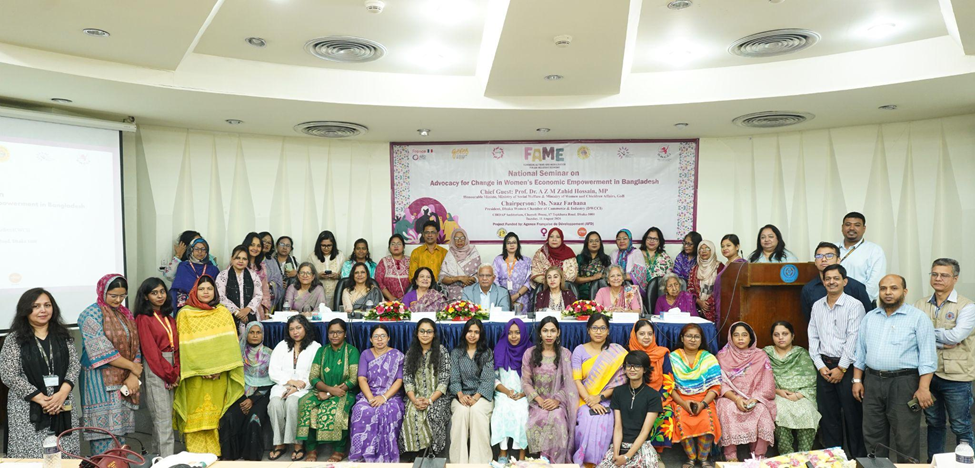
On 11 August 2026, the Dhaka Women Chamber of Commerce & Industry (DWCCI), together with the Centre for Women and Children Studies (CWCS), Concerned Women for Family Development (CWFD) and PURNIMA, organised the National Seminar on “Advocacy for Change in Women’s Economic Empowerment in Bangladesh” at the CIRDAP Auditorium in Dhaka.
More than 155 participants attended the national seminar, including government representatives, development partners, civil society organisations, women entrepreneurs, researchers and women’s rights advocates. The event brought together findings from district-level Gender Lens Assessments and provided a national platform to discuss the barriers affecting women’s economic participation and the actions needed to address them.
The seminar built on Gender Lens Assessment workshops previously held in Satkhira, Khulna and Gazipur, which engaged a total of 293 participants across the three districts. These workshops provided an opportunity for women and other local stakeholders to share their experiences and perspectives on the challenges affecting women’s economic empowerment. Across the three districts, four major barriers emerged consistently: access to finance, mobility, market access and social norms.
Women reported difficulties in accessing formal loans because of collateral requirements, documentation barriers and limited ownership of property. Safe transportation, family restrictions, unpaid care responsibilities and limited access to markets also affected their ability to work, run businesses and expand their economic activities.
One important finding was that access does not always mean control. A woman may receive training, earn an income or have access to credit, but still have limited control over how that income or financial resource is used.
Bringing Local Evidence into National Dialogue
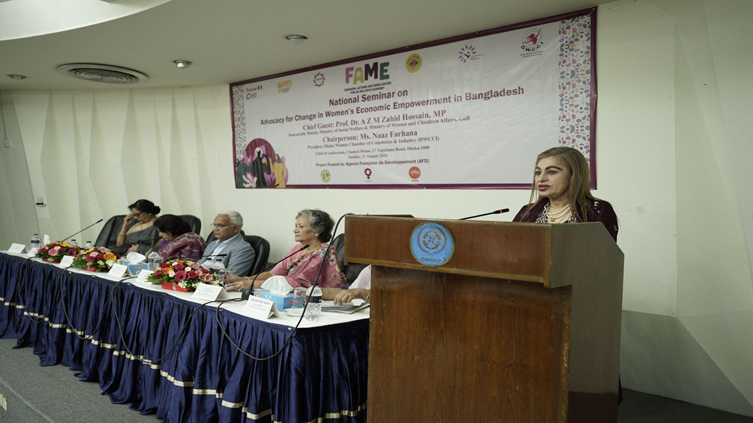
The national seminar provided an important opportunity to bring women’s experiences and local evidence into a wider policy conversation. Prof. Ishrat Shamim, President of CWCS, presented the findings from the district-level Gender Lens Assessments, highlighting the importance of turning women’s experiences into concrete advocacy and policy priorities.
Chaired by Ms. Naaz Farhana, President of DWCCI, the discussion focused on how to create a more enabling environment for women entrepreneurs while addressing the structural barriers that continue to limit their economic opportunities.
The participation of Prof. Dr. A Z M Zahid Hossain, MP, Honorable Minister of the Ministry of Social Welfare and the Ministry of Women and Children Affairs, as Chief Guest, brought a government perspective to the discussion. In his remarks, the Minister highlighted the importance of stronger collaboration between government and civil society, evidence-based policymaking and continued research. He also emphasised the need to strengthen the care economy, increase women’s legal awareness and create stronger links between grassroots initiatives and relevant government programmes.
Ms. Tamanna Binte Rahman, Project Officer at the Agence Française de Développement (AFD), attended as Guest of Honour, reflecting the importance of continued collaboration between development partners, civil society and public institutions in advancing women’s economic empowerment.
The dialogue also brought together civil society organisations, women’s rights advocates and development actors to explore practical barriers faced by women in their everyday economic lives. Discussions covered issues such as safe mobility, working conditions, childcare, access to property and assets, fair wages, digital inclusion and women’s participation in decision-making.
Representatives from the SME Foundation and the National Productivity Organization (NPO) also shared perspectives on how institutions can support women entrepreneurs. The SME Foundation highlighted its work to improve access to finance through women-friendly lending approaches and stronger links between banks and women entrepreneurs. The NPO expressed interest in continued collaboration on research, productivity, advocacy and capacity development.
By bringing together local evidence, women’s voices, civil society and policymakers, the seminar created a space to move from identifying barriers to discussing concrete pathways for change.
Voices from the Field: Lived Realities of Exclusion
The Gender Lens Assessment process created space for women and marginalised entrepreneurs to speak directly about the barriers they face in their daily lives and businesses. Their experiences showed how challenges that may appear separate — access to finance, property, markets and mobility — are often closely connected.
Aleya Khatun, a duck-rearing entrepreneur, described how limited access to property, formal credit and markets affects her business:
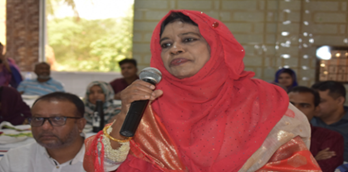
“When I apply for a bank loan, they ask for a government employee as a guarantor and land papers. I have neither because I was denied my family property. As a small woman entrepreneur, I can only get loans from NGOs. I also cannot sell my eggs in the market because of family restrictions and male-dominated markets, so I sell them door to door for less than the market price.”
Uttam Kumar Mitra, a transgender network representative, spoke about the wider discrimination experienced by gender-diverse people:
“Being a Hijra means facing discrimination at every stage of life, from rejection and violence at home to exclusion from education, jobs, property, and public spaces. People tell us to find decent work, yet deny us the opportunities to do so.”
Imrul Hassan Irani, Kinnor Human Welfare Society, highlighted the additional challenges faced by transgender entrepreneurs, including discrimination in business and difficulties with safe mobility:
“As a transgender entrepreneur, vendors often do not take my business seriously, which causes delays and makes me lose customers. Transport is also difficult, as some drivers refuse to carry my products, and many women face sexual harassment while traveling. Our families and neighbors also criticize us for being outside after dark.”
Together, these testimonies illustrate how financial exclusion, mobility restrictions, social attitudes and unequal access to opportunities can reinforce one another, creating additional barriers for women and marginalised entrepreneurs.
From Discussion to Action
The seminar also highlighted the importance of turning these experiences and findings into collective action.Through FAME Window 3, women-led organisations and Community-Based Organisations have used Gender Lens Assessment tools to identify barriers that can remain invisible in conventional economic programmes. These include limited control over income and resources, weak market linkages, unpaid care work, unequal access to property, and the additional barriers experienced by marginalised women and gender-diverse people.
The discussions also highlighted the situation of women working in traditional and small-scale enterprises. Products such as Nakshi Kantha, Jamdani, handloom goods and handicrafts have strong potential in local and wider markets, yet many women producers continue to face difficulties accessing markets and securing fair returns for their work.
A clear message emerged from the seminar: women’s economic empowerment requires more than training or access to finance. Women also need safe mobility, fair access to markets, stronger networks, control over resources and a meaningful voice in the decisions that affect their lives and businesses.
The National Seminar helped connect these local experiences with a broader national dialogue, bringing together grassroots organisations, civil society, development actors and public institutions. It created a space where evidence from the field could inform discussions on policy, finance, markets and the conditions needed for women to participate fully in the economy.
For DWCCI, CWCS, CWFD and PURNIMA, the next step under FAME Window 3 is to carry these findings forward through continued advocacy, policy engagement and regional learning.
By bringing women’s lived experiences to the centre of the discussion, the seminar reinforced an important principle: effective economic empowerment starts by listening to the realities of the women and entrepreneurs it seeks to support.