


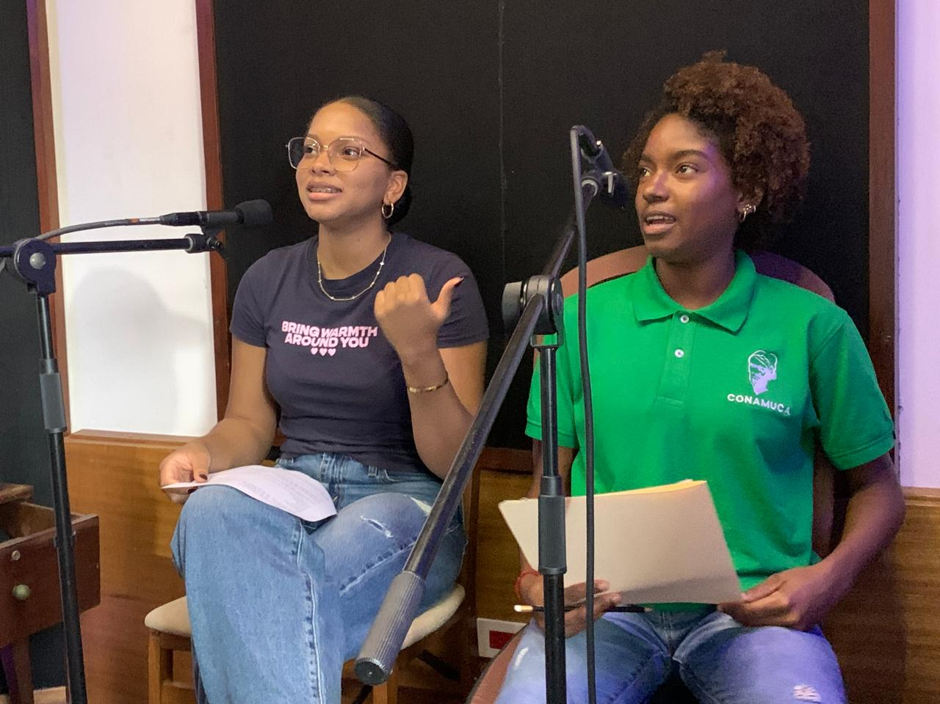
Yeisa, 19, is a member of CONAMUCA’s “Voces Unidas” Youth Network, a rural organization that has been working since 1986 to advance the rights of rural women and girls in the Dominican Republic.
During 2025 and 2026, CONAMUCA carried out a process of organizational strengthening and advocacy with support from CARE, through the project “Feminism: Action and Mobilization for an Inclusive Economy” (FAME). The initiative aims to help women’s organizations and feminist movements build the capacities they need to sustain their work and expand their collective action.
At CONAMUCA, the process ranged from planning and advocacy to strategic communication—an area in which the young women of Voces Unidas began to take on an increasingly active role.
More than 120 rural women, leaders, technical staff members, and young people participated in various stages of the process. Among them were the young women from Voces Unidas, whose involvement in communications ultimately opened up new opportunities for them to engage in the life of the organization.
From Learning to Communicate to Taking on New Responsibilities
In the communication workshops, participants worked on topics such as serving as spokespersons, managing social media, and producing life stories. But the learning didn’t stop at the workshops.
The young women began producing videos and radio spots, creating content for social media, and supporting the promotion and documentation of CONAMUCA’s activities.
For CONAMUCA, having these skills within the organization is particularly important. Its work addresses issues such as the rights of rural women, access to land, food systems, economic autonomy, and climate justice. The fact that women and young people themselves can produce content and document these processes strengthens their ability to communicate their demands and experiences through the organization.
When Communication Opens Spaces for Participation
What began as a process to strengthen communication skills gradually opened up new avenues of participation for young women within CONAMUCA. As they put what they had learned into practice, they began taking on specific tasks in the production of audiovisual and radio content, the management of social media, and the dissemination of the organization’s messages and activities.
Their participation brought new digital and creative skills to CONAMUCA’s work and demonstrated that young women could play a more active role in the organization’s communication efforts. For this reason, the organization decided to continue integrating Voces Unidas into communication, mobilization, and advocacy efforts, in coordination with the National Board of Directors and the technical team.
This decision ties into a broader challenge: generational transition. For an organization with nearly four decades of history, ensuring the continuity of its work also means creating opportunities for new generations to develop skills, take on responsibilities, and find their own ways to participate.
For Yeisa, that journey began with something very concrete: daring to speak in front of a camera. Today, she can use it to help share the work, experiences, and demands of the rural women who are part of her organization.
And that change goes beyond learning to communicate: it means that a new generation is beginning to find and build its place within CONAMUCA.

